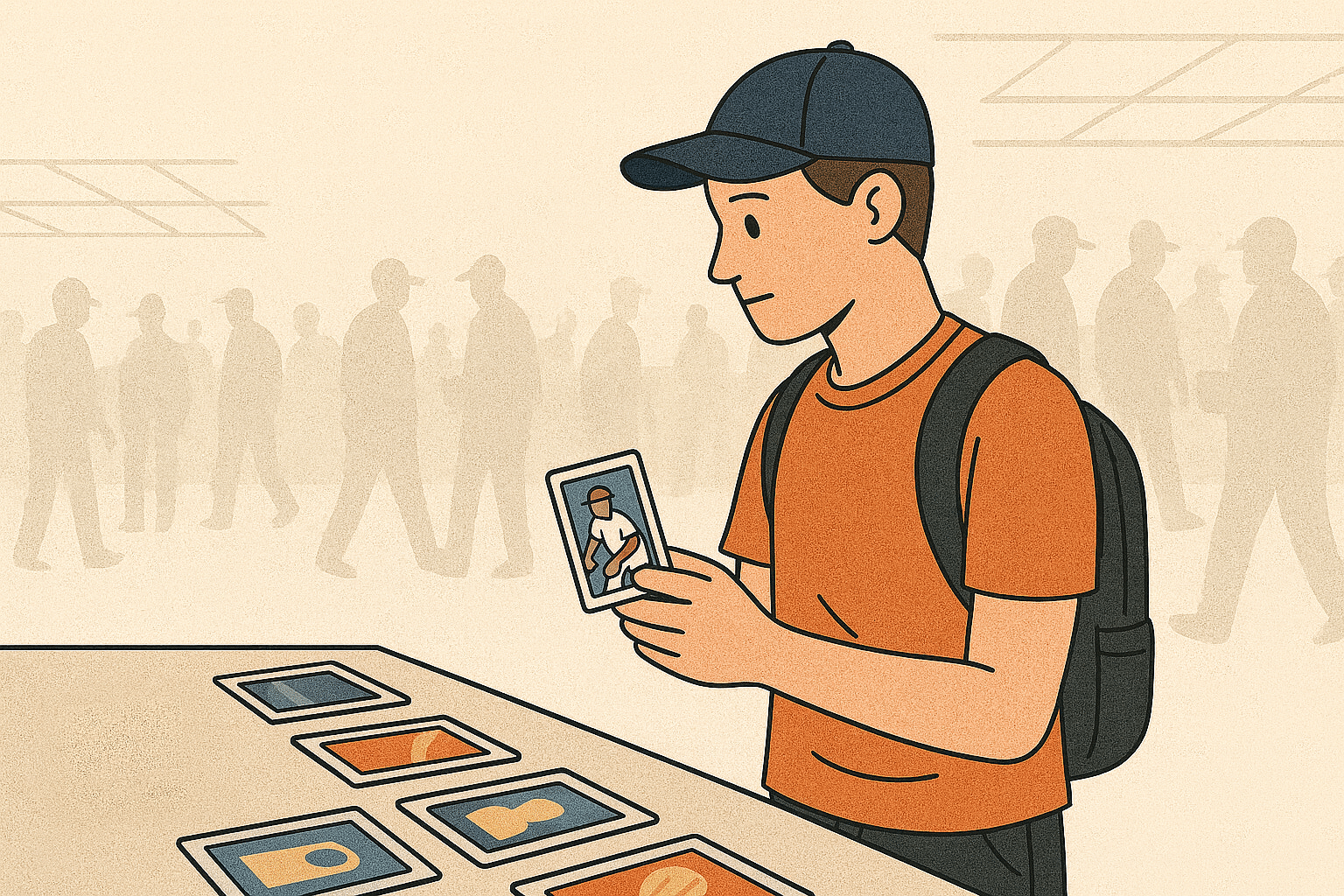
Bring cash in small bills, a phone for looking up sold prices, protective supplies for whatever you buy, and a written list of what you’re hunting. Bring less money than you think you need. Those four things cover most of what goes wrong at a first show.
A card show is a room full of tables, each rented by a dealer who brought their own inventory and sets their own prices. Nobody coordinates anything. The same card can be priced very differently from one table to the next, and that variation is the single most useful fact for a first-timer.
Here’s how to walk in prepared, how to check a price at the table, and what to expect if you’re bringing cards to sell.
What to bring
- Cash, in small bills. Plenty of dealers take payment apps now, but cash still gets better prices, and having twenties and fives lets you make an offer that’s actually a round number. Splitting your cash between two pockets makes it much easier to hold a budget.
- A phone, plus a charger or battery pack. You’ll be looking up sold listings all day, and show halls are hard on batteries.
- Supplies for what you buy. Penny sleeves and toploaders, and a small hard case or box to carry them in. Dealers usually sleeve what they sell you, but not always, and you don’t want a good card riding loose in a pocket.
- A written want list. Player, set, year, and the most you’ll pay for each. On paper or in your notes app — written, not remembered. This is the thing that stops you buying nine cards you don’t care about.
- Comfortable shoes and water. Not a joke. Shows are concrete floors and several hours.
- If you’re selling or trading: your cards sorted, in a binder or box, with the good ones separated and protected. Nobody wants to dig through a shoebox.
First card show tips for not overpaying
The core skill is simple, and most first-timers skip it: walk the entire room before you buy anything.
Do one full lap with your hands in your pockets. Note where the cards you want are and what they’re priced at. You’ll regularly find the same card at two tables at meaningfully different prices, and you can only know that if you’ve seen both. Dealers talk in shorthand while you do it — comps, PC, grail, SP — and a quick pass through the vocabulary makes the room much easier to follow.
Then, on anything that matters:
- Check sold listings on your phone before you pay. Search the exact card on eBay — year, set, parallel, grade — then filter to Sold Items and sort by most recent. Look at the last several sales and at their dates, and use the middle of that range rather than the highest number you see. It takes about ninety seconds, and it’s the difference between paying a fair price and paying an asking price.
- Ask “what’s your best on this?” It’s a normal question, not an insult. Most dealers have room, especially on multiple cards.
- Bundle. Pick three or four cards from one table and ask for a price on all of them together. That’s where the real discounts live.
- Inspect raw cards under the light. Tilt the card so you’re looking across the surface, not straight down — scratches and print lines only show at an angle. Check the corners for softness and the edges for chipping. Compare the left border to the right and the top to the bottom: a noticeably off-center card is worth less, and much less if you were planning to grade it.
- For slabs, look up the cert number on the grading company’s website right there at the table. It confirms the card and grade on the label match what the company actually issued.
- Be careful with expensive raw vintage. Trimming and recoloring exist and they’re genuinely hard to spot without experience. If it’s expensive and it’s raw, either buy it graded or buy it from someone whose name and table you can find again.
If you’re bringing cards to sell
Set your expectations before you walk in, because this is where first shows most often go badly.
A dealer buying your cards has to resell them. They offer a percentage of what they think they can eventually get, and that percentage has to cover their table fee, their time, their supplies, and the risk that the card sits in their case for a year. An offer well below what the card sells for online is normal rather than insulting — you’re buying speed and certainty from them, and you pay for that in margin. How an offer on a whole collection gets built uses the same arithmetic, just at a larger scale.
| How you sell | You get | You give up |
|---|---|---|
| Dealer at a show | Cash today, no fees, no shipping, no risk | The largest share of the card’s retail value |
| Consignment | Closer to market price | A percentage, and weeks or months of waiting |
| Selling it yourself online | The most money, in theory | Fees, shipping, packing time, scam risk, and your own hours |
Sort your cards before you go and know roughly what the good ones sell for, so you can tell a low offer from a bad one. Selling in person also skips the risk of a package going missing or arriving damaged. And don’t bring a giant box of base cards expecting interest — dealers already have thousands of those and can’t sell them either.
If what you’re carrying is a box from a relative’s attic rather than a collection you built, do the first pass at home — what to do with cards found in an attic comes before a table. A box too big for one dealer to take in an afternoon is a collection buyout rather than a show sale: shops and auction houses all do those, and selling a whole collection to us works on the same speed-versus-price tradeoff. And renting your own table is a different job again — selling from behind the table covers pricing and setup.
A note about bringing kids
One of the more common posts you’ll see after a show weekend is a parent describing a kid who set up a table or brought a binder to sell and had nobody stop by. That happens a lot, and it usually isn’t about the cards.
Show traffic moves toward dealers with recognizable inventory and familiar faces. A kid with a binder of cards pulled from packs is competing with people who’ve been doing this for twenty years and who buy at prices a kid isn’t going to match. It’s not a judgment on the collection.
What tends to work better is going to buy and trade rather than to sell. Give the kid a set budget and a want list and let them negotiate their own deals. Dealers are generally patient and generous with kids who are genuinely interested, and a kid who talks a dealer down two dollars remembers that a lot longer than a sale. If they do want to sell, take the cards to two or three tables and ask what each would offer, and treat the low answers as information about how the business works rather than about the cards.
Etiquette that gets you treated well
- Ask before touching cards or reaching into a case.
- Handle cards by the edges, with clean dry hands.
- Don’t camp at a busy table for twenty minutes with no intention of buying.
- Don’t loudly tell a dealer their prices are too high. Just move on.
- Come back near closing. Dealers who’d rather not pack everything up are often more flexible in the last hour.
Your next step
Before your first show, write your want list and your total budget on a piece of paper and put it in your pocket. Then do the full lap before you buy anything. Those two habits will save you more money than any amount of price knowledge, because the most expensive mistake at a first show is enthusiasm, not ignorance.
Common questions
What should I bring to my first card show?
Cash in small bills, a phone and battery pack for checking sold listings, penny sleeves and toploaders for what you buy, a written want list with maximum prices, and comfortable shoes. If you’re bringing cards to sell or trade, bring them sorted and protected.
Is haggling expected?
Yes, politely, and especially on multiple cards. “What’s your best on these three?” is the standard phrasing. Hard lowballing on a single cheap card mostly just annoys people; asking for a bundle price is ordinary business.
How much money should I bring?
Less than you’re tempted to. Decide your total before you go, bring that amount in cash, and leave the cards at home. A show is designed to make you spend, and the room does a good job of it.
Are prices at shows better than online?
Sometimes. You save on shipping and often on fees, and you can inspect the card in person, which is a real advantage on raw cards. But dealers price for a room full of people who can’t comparison shop easily. Checking sold listings at the table is what keeps show prices honest for you.